


Business: business@xtoolonline.com
Social Media Cooperation: Media@xtoolonline.com
Support: support@xtoolonline.com

If your scanner displays catalyst system efficiency below threshold, you may immediately assume that the catalytic converter needs to be replaced. In reality, that is only one possible cause.
This warning is commonly associated with P0420 (Bank 1) and P0430 (Bank 2). The engine computer has detected that the catalyst is not reducing emissions as effectively as expected. However, an exhaust leak, faulty O2 sensor, engine misfire, or incorrect air-fuel mixture can also trigger the code.
Before spending hundreds or thousands of dollars on a catalytic converter, diagnose the system first.

The catalytic converter is designed to reduce harmful exhaust emissions before they leave the vehicle. The PCM or ECM monitors its performance using oxygen (O2) sensors positioned before and after the converter.
The upstream O2 sensor monitors exhaust gases entering the catalytic converter and is also involved in air-fuel control. The downstream O2 sensor monitors the exhaust after it passes through the catalyst.
A functioning catalytic converter stores and releases oxygen as part of the chemical conversion process. Therefore, the downstream O2 signal should generally be more stable than the upstream signal under appropriate operating conditions.
When the PCM determines that catalyst performance has fallen below its programmed threshold, it can set a catalyst-efficiency code.
On a V6 or V8 engine, Bank 1 is the cylinder bank containing cylinder #1, while Bank 2 is the opposite bank.
The exact monitoring strategy varies by manufacturer, so vehicle-specific service information should always be considered when diagnosing these codes.

A catalyst-efficiency code does not identify a single failed component. Common causes include:
The catalyst can lose efficiency because of age, overheating, contamination, physical damage, or prolonged exposure to abnormal engine conditions.
A severely damaged converter may also become restricted, causing poor acceleration or loss of engine power.
An aging or inaccurate O2 sensor can provide incorrect information to the PCM.
However, replacing an O2 sensor simply because P0420 appears is not a reliable diagnostic strategy. Sensor-related codes, wiring problems, live-data behavior, and other operating conditions should be checked first.
An exhaust leak upstream of the downstream sensor can introduce outside oxygen into the exhaust stream and affect sensor readings.
Inspect for cracked pipes, damaged gaskets, loose connections, soot marks, and unusual ticking or hissing noises.
This is one of the most important areas to investigate.
A misfiring engine can send unburned fuel into the exhaust. That fuel can burn inside the catalytic converter and create excessive temperatures, potentially damaging the catalyst.
Likewise, persistent rich or lean conditions can affect catalyst operation.
If the vehicle also has codes such as P0300, P0301-P0308, P0171, or P0172, diagnose those problems before condemning the catalytic converter.
In other words, the catalytic converter may sometimes be the victim rather than the original cause.
Oil consumption, coolant entering the combustion chamber, or certain fuel contaminants can damage the catalyst over time.
Replacing the converter without correcting the underlying engine problem can result in another catalyst failure.

This is where many DIY repairs go wrong.
A driver sees P0420, searches for the code, and immediately orders a catalytic converter. After installation, the Check Engine Light eventually returns.
Why?
Because the original problem may have been an exhaust leak, misfire, fuel-control problem, or inaccurate sensor reading.
The better approach is to treat P0420 as a diagnostic starting point—not a parts-replacement instruction.
Connect an OBD2 scanner and perform a complete diagnostic scan.
Don't look at P0420 in isolation. Check for:
If another fault explains why the engine is producing abnormal exhaust gases, address it first.
If your diagnostic tool provides freeze-frame information, examine the engine conditions when P0420 was stored.
Useful information can include:
This can help determine whether the code occurred during idle, cruising, acceleration, or another operating condition.
Before replacing expensive components, inspect the exhaust system for leaks.
A small leak may not always be obvious when the engine is cold, so pay particular attention to connections around the exhaust manifold, catalytic converter, and O2 sensors.

This is where a professional diagnostic tool with live-data graphing becomes especially useful.
On many conventional systems, the upstream O2 sensor changes relatively quickly as the PCM adjusts the air-fuel mixture. The downstream sensor should generally show a more controlled signal when the catalyst is operating correctly.
If the downstream sensor closely follows the upstream sensor, catalyst oxygen-storage performance may be reduced.
But there is an important diagnostic warning:
An O2 waveform alone does not prove that the catalytic converter is bad.
Sensor design, fuel strategy, exhaust conditions, engine temperature, and manufacturer-specific monitoring logic can all affect the readings.
Use the waveform as evidence together with other tests rather than treating it as a simple pass/fail test.
Look at short-term and long-term fuel trims when supported by the vehicle.
Abnormal fuel trims may point toward vacuum leaks, fuel-delivery problems, MAF issues, or other engine conditions that can affect catalyst performance.
If the scanner supports misfire counters, check them as well.
For more advanced diagnosis, Mode $06 can provide additional information about onboard emissions-monitor test results.
Depending on the vehicle, Mode $06 may allow you to see catalyst-monitor test values and their relationship to the applicable limits.
However, Mode $06 data is manufacturer-specific. TID/CID definitions and acceptable ranges can vary, so don't apply a universal number to every vehicle.
A professional diagnostic tool that provides both live data and Mode $06 information can therefore give you substantially more diagnostic evidence than a basic code reader.
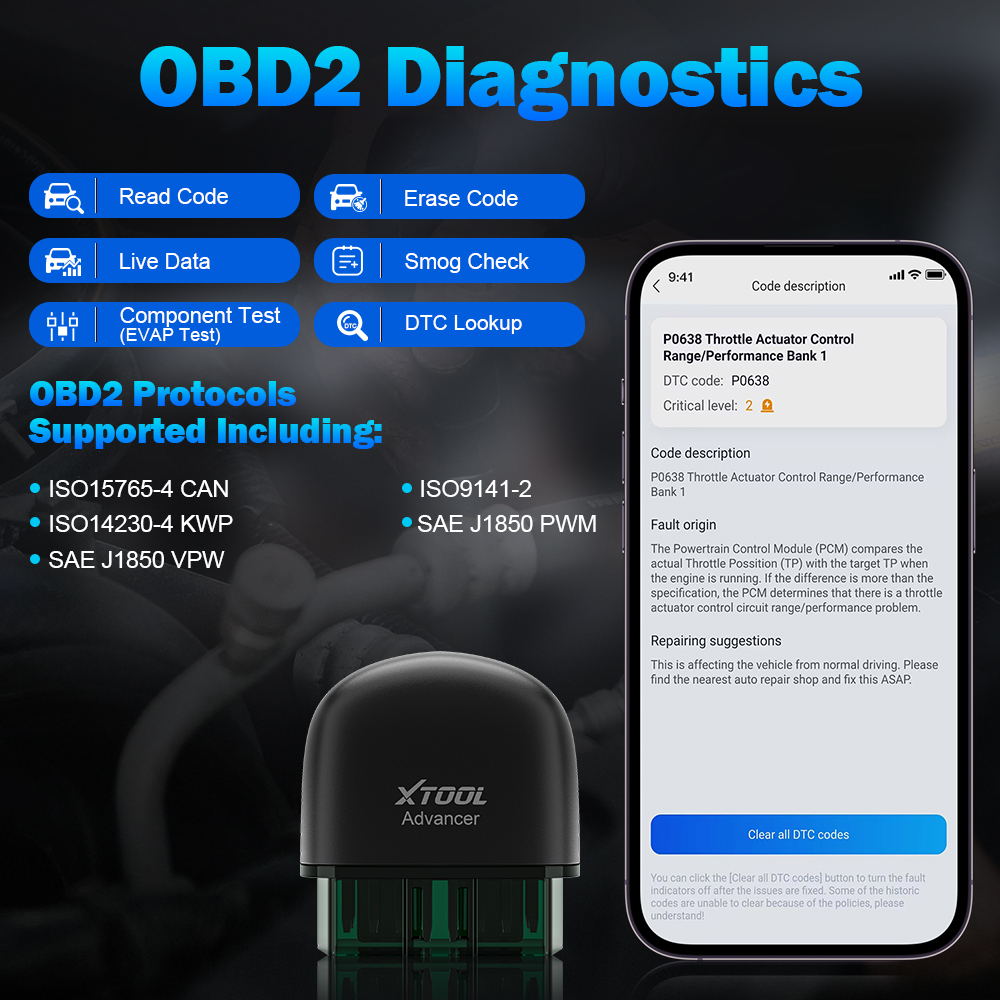
If the Check Engine Light is solid and the vehicle runs normally, P0420 does not necessarily mean the vehicle will immediately break down.
However, ignoring it indefinitely is not recommended.
The situation becomes much more urgent if you have:
A severe misfire can rapidly overheat the catalytic converter and cause additional damage.
An unresolved emissions fault may also cause the vehicle to fail an applicable emissions or smog inspection.
Clearing the diagnostic trouble code does not repair the underlying problem.
When you clear P0420, the PCM resets the stored fault and related monitor information. The catalyst monitor must then run again when the vehicle meets the required operating conditions.
If the PCM detects that catalyst efficiency is still below its threshold, the code can return.
This explains why clearing the code and seeing what happens is not a real repair strategy.

In some cases, P0420 can be resolved without replacing the catalyst.
Potential repairs include:
Catalytic-converter cleaning products may help in limited situations involving deposits, but they cannot repair a melted, physically damaged, contaminated, or severely degraded catalyst.
Avoid methods designed only to suppress the O2 sensor signal or hide the catalyst monitor. They may turn off the warning temporarily without solving the emissions problem.
Actual prices depend heavily on the vehicle, parts quality, labor rates, and location.
| Potential Repair | Typical Difficulty | Approximate Cost |
|---|---|---|
| O2 Sensor Replacement | Medium | $150–$350 |
| Exhaust Leak Repair | Medium–Hard | $100–$400+ |
| Misfire/Fuel-System Repair | Varies | $100–$1,000+ |
| Catalyst Cleaner | Easy | $15–$30 |
| Catalytic Converter Replacement | Hard | $800–$2,500+ |
Before purchasing an expensive catalytic converter, check whether the vehicle has applicable emissions warranty coverage or manufacturer-specific service information.

A basic code reader can tell you that P0420 exists.
A more capable vehicle diagnostic tool can help determine why it exists.
Features such as live-data graphing, fuel-trim monitoring, misfire data, full-system scanning, and Mode $06 access can provide much more information before expensive parts are replaced.
That difference matters. Spending a few minutes analyzing O2 data and related engine parameters can be far cheaper than replacing a catalytic converter unnecessarily.
No. P0420 means the PCM has detected catalyst efficiency below its expected threshold. Exhaust leaks, O2 sensor problems, misfires, and fuel-mixture issues should be ruled out first.
Yes. A faulty spark plug can cause an engine misfire. Unburned fuel can enter the exhaust and overheat the catalytic converter, eventually contributing to catalyst failure.
Yes, a faulty sensor or sensor circuit can affect catalyst monitoring. However, don't replace the sensor based solely on P0420. Confirm the sensor's operation and check for other causes.
A vehicle with a solid Check Engine Light and normal operation may remain drivable, but the cause should still be diagnosed. A flashing Check Engine Light or severe misfire requires much more urgent attention.
No. Clearing the DTC only resets the stored fault. If the underlying condition remains, the catalyst monitor can detect the problem again and set P0420.
Start with a complete scan, check freeze-frame data and other codes, inspect the exhaust, analyze O2 sensor live data, review fuel trims and misfire information, and use Mode $06 when available. This evidence-based approach is much safer than immediately replacing the catalytic converter.
Catalyst system efficiency below threshold is a warning that requires diagnosis—not an automatic instruction to replace the catalytic converter.
Whether the vehicle has P0420 or P0430, start by looking for the underlying cause. Check for exhaust leaks, O2 sensor problems, misfires, fuel-mixture issues, and abnormal engine conditions before condemning the catalyst.
With an OBD2 scanner or professional diagnostic tool capable of live data and advanced diagnostic functions, you can gather much stronger evidence and avoid the expensive parts-cannon approach.
The goal is not simply to clear the Check Engine Light. The goal is to determine why catalyst efficiency fell below the threshold and fix the root cause.


Business: business@xtoolonline.com
Social Media Cooperation: Media@xtoolonline.com
Support: support@xtoolonline.com